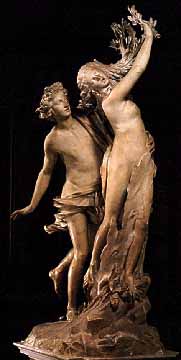
 Daphne is transformed into the noble Laurel Tree to escape Apollon
|
The Shadow of Olympus:
APOLLON AND DAPHNE
By: Duygu
http://www.seyahatname.150m.com
One day, long ago, upon the slopes of Mount Parnassos far-shooting Apollo came upon the child Eros* stringing his little bow. "Leave the lethal weapons to grownups." He said. "Other toys would best suit you. Bows and arrows are for Gods like myself."
Little Eros continued to string his little bow without so much as a look in Apollo's direction. His bow ready, he perched himself on a ledge overlooking a grassy field and took two small arrows from his quiver; one, sharp as the passions it inspired, the other dull as the apathy it was meant to bring forth. Two arrows with opposite effects.
Below him was Daphne, daughter of Peneus, lusty lord of the river, picking small blossoms off the field. Eros let fly the dull arrow deep into the breast of the young beauty. The other arrow he let fly at Apollo, divine son of Leto as his eyes fell upon the lovely girl.
In an instant, his heart was filled with a passion so intense, even a god finds difficult to resist. A passion for Daphne, daughter of Peneus. At that same instant, all thoughts of marriage, of men, and indeed of love became loathsome to the mortal maid. Apollo watched the girl skip along the field, dancing a joyous dance. Her every movement was rapture. The movement of her hair in the wind, the shape of her lovely arms, and most of all, that which was hidden by her flowing robes inflamed the passions of Apollo. "She is mine." He said as he ran across the field to pay her court.
Daphne ran into a nearby woods.
"Don't run!" Apollo yelled, his heart filled with love and lust for the beautiful girl. "It is I, lord of Delphi, son of Zeus. Allow me to play you a song. Oh beautiful nymph, let me pluck my lyre for you."
The more he spoke, the faster she ran. Her heart filled with feelings of disgust and anguish at the thought of his very presence. She ran faster and faster, but he continued close behind. Her every though of escape and freedom from a horrible fate. She ran through the woods, the winds playing havoc with her hair and loose fitting robes. It gave her a wild aspect, a look of savagery that further inflamed the passions of her suitor. As she ran down a hill, the branches of a tree caught on her robes, tearing them from her body as she ran from Apollo. The sight of his fair maiden running naked through the woods gave Apollo further cause for speed, and he closed the distance between them.
She could almost feel his breath upon her neck as she realized the familiarity of this place. She could see the river, her father's home, and called out to him. "Father," She said. "If you have the power, clothe with green this body no longer mine. Save me from this fate!"
All at once, her feet became rooted to the ground. Delicate buds sprang forth from her outstretched fingers. Her hair became a wild a shocking array of leaves. Her body the trunk of a laurel tree. Shocked, disappointed, and heart broken, Apollo pulled a small branch of leaves from the new tree, forming into a crown he placed upon his head. The crown that would be worn by those marrying.
*The Eros referred to in this story was the child of Aphrodite. A cherub like being who is better known today as Cupid, not the Eros who was born at the beginning of things and who was identified as the impulse of life toward copulation and procreation as well as the force of gravity.
HERMAPHRODITOS AND SALMACIS
BY: Margaret Penn
It came as no surprise to the nymphs on Mount Ida that the child placed in their care was beautiful beyond description. The boy, after all, was the son of Aphrodite, goddess of love and beauty, and swift-footed Hermes, messenger of the gods.
Just as he possessed the best attributes of each of his parents -- his father's natural athletic ability as well as his mother's charms -- so, too, did he take both of their names into his own. He was called Hermaphroditus.
Soon the child was not a mere boy, but a young man, longing to see the world. So he said goodbye to the nymphs who had raised him and ventured out to see what the rest of the world had to offer.
As he traveled through forests, past natural springs and along seacoasts, Hermaphroditus was entranced by the beauty that was all around him. And, perhaps because he was raised to accept such things, he would often meet the normally secretive spirits who protected these wonders.
The Oreads were the nymphs of the mountains, and included the ones who had nurtured him as an infant. And, although he knew their nature well, the new ones he ran into in his travels still managed to surprise him now and then by sneaking up on him noiselessly across boulders and loose rocks.
Dryads, if anything, were even more adept at concealing themselves. As forest nymphs they had more places to hide. But young Hermaphroditus would always eventually triumph over their natural shyness with his divinely handsome features and boyish charms.
By the rocky coasts of the sea, where the wilds from above meet the wilds from below, he chanced across some of the Nereids. Although they could not stay for long, as you could well expect of nymphs who tended such waters, they indulged themselves long enough for a short but pleasant conversation. And, after promising to introduce him to their Oceanid cousins if he should chance their way again, they flitted under the foam and across waves until he could no longer hear their giddy laughter in the distance.
Hermaphroditus also encountered the Naiads, protectors of pools and springs. One particular member of this group would change his life forever. This is as much her story as it is his.
The nymph Salmacis, who was as beautiful as Hermaphroditus was manly, lived in a fountain of perfectly clear water near Halicarnassus. There has been much debate by storytellers and philosophers about where the pool ended and the nymph began, or if there were any difference between the two at all. It is only safe to say they were the same, but also different.
Like others of her kind, she was the living spirit of the water she inhabited. Although she was also capable of walking away and leaving the place for a time, she rarely left the fountain. Salmacis preferred to lounge by the edge and arrange the ferns that grew there to her liking, gaze at her lovely reflection in the water or comb her hair until every strand was just exactly where she thought it looked best.
Other nymphs would join hunting parties in the forest or compete in races or other athletic events. Salmacis had no interest in such pursuits. Beauty was all that mattered to her.
Once one of her many sisters gave her a quiver of her own, thinking the gesture might prompt her to join in that day's deer hunt. Salmacis did not even pretend to be grateful. Without even a word of thanks or apology she threw the finely-honed arrows into a disorganized pile and walked into the woods to gather flowers in the now empty quiver.
As she returned with her sweet-smelling bouquet she heard splashing in her fountain. Infuriated at the thought that one of her deer-killing sisters may be daring to wash off blood from a hunt in her sparkling waters, she threw the quiver aside and ran the rest of the way.
But when she got there quite a different sight awaited. There was a man standing in her pool, washing off dust from his recent travels. This certainly would have offended her if it weren't for the fact that this man possessed a god-like physique and devilish handsomeness.
Although startled by her sudden appearance, Hermaphroditus spoke graciously, asking for forgiveness if his presence had been unexpected. Salmacis had never heard such a wondrous sound as this man's voice. And when he turned his head slightly as if to ask why she did not respond, she noticed the piercing glint of his eye and the strength of his jaw. Every single thing about him seemed to be more splendid than the best of any other man she'd ever seen had to offer. She was only moved to action when he turned as if to leave the fountain.
Salmacis quickly jumped in front of him to block his departure. She promised undying love if he became her husband, unquestioning servitude if he were a god, even exquisite pleasures if he just wanted a discrete lover. She swore all three and more if he would return her affections.
Hermaphroditus was startled and even a bit frightened by this sudden adoration. He was certainly used to a certain amount of attention, but this intensity went beyond anything he had experienced, seen or even conceived of. He decided his best chance was to run for the woods and try to sort things out later.
But before he could even start to flee, Salmacis detected his intent in his eyes. She leapt upon him in an instant. They both tumbled into the waters, legs and arms twisted around each other. For all his strength Hermaphroditus could not seem to free himself from her grasp.
The feeling of his skin upon hers only strengthened her resolve to never let him go. In near ecstasy, Salmacis shouted to the heavens, imploring the Fates or the gods or whomever would listen to never allow the two of them to be separated.
And somehow, from her strength of will and his divine heritage, between the thrashing of the pure water and the twisting of limbs, man and woman merged into one form. It had one pair of arms, one set of legs, one head and one face but was both male and female at the same time. The combination took the worst attributes of both beings but none of the good traits of either.
So Hermaphroditus, who was both male and female in name, cursed the pool for making him the same in body. To this day men hesitate to drink or bathe in waters taken from the fountain of Salmacis in fear that a similar fate shall befall them as well.
ECHO AND NARCISSUS
BY: Thomas Bulfinch
Echo was a beautiful nymph, fond of the woods and hills, where she devoted herself to woodland sports. She was the favorite of Diana, and attended her in the chase. But Echo had one failing; she was fond of talking, and whether in chat or argument, would have the last word.
One day Juno was seeking her husband, who, she had reason to fear, was amusing himself among the nymphs. Echo by her talk contrived to detain the goddess 'til the nymphs made their escape.
When Juno discovered it, she passed sentence upon Echo in these words: "You shall forfeit the use of that tongue with which you have cheated me, except for that one purpose you are so fond of -- reply. You shall still have the last word, but no power to speak first."
This nymph saw Narcissus, a beautiful youth, as he pursued the chase upon the mountains. She loved him and followed his footsteps. O how she longed to address him in the softest accents, and win him to converse, but it was not in her power. She waited with impatience for him to speak first, and had her answer ready.
One day the youth, being separated from his companions, shouted aloud, "Who's here?"
Echo replied, "Here."
Narcissus looked around, but seeing no one, called out, "Come."
Echo answered, "Come."
As no one came, Narcissus called again, "Why do you shun me?" Echo asked the same question.
"Let us join one another," said the youth. The maid answered with all her heart in the same words, and hastened to the spot, ready to throw her arms about his neck. He started back, exclaiming, "Hands off! I would rather die than you should have me!"
"Have me," said she; but it was all in vain. He left her, and she went to hide her blushes in the recesses of the woods.
From that time forth she lived in caves and among mountain cliffs. Her form faded with grief, 'til at last all her flesh shrank away. Her bones were changed into rocks and there was nothing left of her but her voice. With that she is still ready to reply to anyone who calls to her, and keeps up her old habit of having the last word.
Narcissus's cruelty in this case was not the only instance. He shunned all the rest of the nymphs, as he had done poor Echo.
One day a maiden who had in vain endeavored to attract him uttered a prayer that he might some time or other fell what it was to love and meet no return of affection. The avenging goddess heard and granted the prayer.
There was a clear fountain, with water like silver, to which the shepherds never drove their flocks, nor the mountain goats resorted, nor any of the beasts of the forests; neither was it defaced with fallen leaves or branches, but the grass grew fresh around it, and the rocks sheltered it from the sun.
Hither came one day the youth fatigued with hunting, heated and thirsty. He stooped down to drink, and saw his own image in the water; he thought it was some beautiful water-spirit living in the fountain. He stood gazing with admiration at those bright eyes, those locks curled like the locks of Bacchus or Apollo, the rounded cheeks, the ivory neck, the parted lips, and the glow of health and exercise over all.
He fell in love with himself. He brought his lips near to take a kiss; he plunged his arms in to embrace the beloved object. It fled at the touch, but returned again after a moment and renewed the fascination. He could not tear himself away; he lost all thought of food or rest, while he hovered over the brink of the fountain gazing upon his own image.
He talked with the supposed spirit: "Why, beautiful being, do you shun me? Surely my face is not one to repel you. The nymphs love me, and you yourself look not indifferent upon me. When I stretch forth my arms you do the same; and you smile upon me and answer my beckonings with the like."
His tears fell into the water and disturbed the image. As he saw it depart, he exclaimed, "Stay, I entreat you! Let me at least gaze upon you, if I may not touch you." With this, and much more of the same kind, he cherished the flame that consumed him, so that by degrees he lost his colour, his vigour, and the beauty which formerly had so charmed the nymph Echo. She kept near him, however, and when he exclaimed, "Alas! alas!" she answered him with the same words.
He pined away and died; and when his shade passed the Stygian river, it leaned over the boat to catch a look at itself in the waters. The nymphs pined for him, especially the water-nymphs; and when they smote their breasts Echo smote hers also. They prepared a funeral pile and would have burned the body, but it was nowhere to be found; but in its place a flower, purple within and surrounded with white leaves, which bears the name and preserves the memory of Narcissus.
|
|
SABEANS(SABIANS) OF HARRAN
BY: AJAE
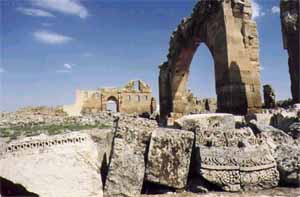
The city of Harran was founded around 2000 BC as a merchant outpost of Ur, situated on the major trade route across northern Mesopotamia (42). The name comes from the Sumerian and Akkadian "Harran-U", meaning "journey", "caravan", or "crossroad" (43).
For centuries it was a prominent Assyrian city, known for its Temple of Sin, the Moon God (44).
The theology of the Harranians can be divided into three periods. The first is the Assyrian-Babylonian period from about 2000 BC up to the beginning of the Christian era. During this time Sin was the supreme deity. The second period can be noted as being from the beginning of the Christian era to the Islamic period. During this time the Harranians still clung to their belief in Sin and appear to have expanded into various sects. The third period begins in the 10th century AD. This time period gives us a wealth of information on the Harranians. Not only do the Harranians retain Sin, but also they now claim to have been descended of Abraham and note Adam among their ancestors. (45)
The Assyrian Babylonian Period
The religion of the ancient Mesopotamian people left its mark on the entire Middle East. The literature, cosmogony and rituals influenced the major religious ideas today of Judeo-Christian-Islamic tradition. Archaeologists are reconstructing the religious world of Mesopotamia through the ancient these ancient temples, ziggurats, and the cuneiform writings of hymns, myths, lamentations, and incantations.
Each city housed a temple that was the seat of a major god in the Mesopotamian pantheon. Some of these temples evolved into massive ziggurats. These gods controlled the powerful forces, which often dictated the fate of all humans. The priesthood in the beginning had the duty to please the town's patron. That job soon passed to the secular kings. Yet the priesthood did manage to hold great authority through the interpretation of omens and dreams. (46) Although the gods preferred justice and mercy, they also created evil and misfortune. A mortal could do about it, the best one could do in times of duress would be to "plead, lament and wail, tearfully confessing his sins and failings." Man was created as a tool for the use of the gods and at the end of everyone's life, lay the underworld, a gloomy dreary place full of shadows. (47)
The temple was very simple, rectangular in shape with a brick alter called a “cellaâ€Â. (48) Priests, priestesses, musicians, singers, and castrates staffed the temple. On a daily basis various public rituals, food sacrifices, and libations took place there. In addition there were many monthly and annual celebrations.
Harran, as well as Ur, was the center of Sin, the moon god. The status of Sin was so great that from 1900 BC to 900 BC his name is witness to the forging of international treaties as the guarantor of the word of kings. Sin is also called Nanna(or Nanna-Sien). Sin is represented by either a bull or as a old man with a lapis lazuli beard with a cap on which there are bull’s horns. Sin is conceived when his father Enil (god of the air) rapes Ninlil (Ningal). (49)
In the inscriptions of Nabonidus from Harran, we learn that the children of Sin, Ishtar (Inanna) goddess of love and war and Shamash (Utu) god of the Sun were worshipped as well. But these were not the only deities worshipped at Harran. Ningal, Nusku, and Sadarnunna as well as the lesser gods of Nabo Adai, Ter, Ã…Â er, and Allai were all worshipped to some degree. (50)
Shalmanester of Assyria restored the temple at Haran, called e-hul-hul, in the 9th century BC, and again by Asshurbanipal. About 550 BC, Nabonidus the last king of Babylon, who originated from Harran, rebuilt the temple of Sin as directed by a dream. His mother was high priestess at Harran and his daughter at Ur. (51)
The Beginning of the Christian era to the Islamic period
During this period Sin remains the most important figure in Harranian life. A trinity is developed with Sin, Ishtar and Shamash. They are represented as a crescent with two stars. Roman coins of the period show Harranian influence.
The importance of the temple of Sin is noted by various references. In 217 AD Emperor Caracala was killed after he was returning from visiting the temple of the moon god in Harran. In 363 AD Emperor Julian paid his respects to the temple of Sin. In the Doctrine of Addai, the author writes of the moon god at Harran. Jacob of Searug also writes of the god Sin, the moon god of Harran. (52) The Harranians are also heavily influence during this period by the Christians and other religious groups, including those of the baptizing sects, which would included the Mandaeans. After the conquests of Alexander, Harran came to be a center of intellectual and religious activity, which evolved into a philosophical tradition centered on Hermes Trismegistus. (53) At one time Hermes Trismegistus was thought to be an Egyptian priest who lied in very ancient times and wrote a series of magical books which became known as Hermetic literature. In reality Hermetic literature, is a series of books written by various authors that contained a mixture of popular Greek philosophy, Platonism, and Stoicism that were influenced by Jewish and Persian religious theology. (54)
But still at this time there is no indication of a traditional history with Abraham or Adam or a theology including these two figures being practiced by the Harranians.
Islamic Period
The Harranians came under Islamic rule about 639 AD. The Harranians were described as Nabataeans pagans and Greek immigrants. The Harranians made calculated moves and advanced into politics. They made peace with the Muslims and began to form ties with them. The fortunes of the Umayyad Dynasty were due to the Harranian’s political and military force. In fact the Caliph Marwan (744-750 AD) made Harran his home and moved the Umayyad Empire from Damascus to Harran. Then in 830 AD the Caliph al-Ma’mun demanded that the pagans of Harran either change religions or accept death. They chose to be identified with the “Sabiansâ€Â. This began one of the most successful “con jobs†in history that still permeates our beliefs of the Harranians even today. They also were able to have the School of Philosophy and Medicine moved from Alexandria to Harran. In addition a number of famous scholars are said to have come from Harran. (55)
The term Sabians of Harran only appears in the late 9th century. Before this date they were referred to only as Chaldeans or Harrians or Nabataeans. The later Moslem writers describe (after the Caliph al-Mamun 832-833 AD) describe these Sabians as people who worship planets, idols, stars, and are located in the city of Harran. The Harrians adopted the name Sabians for two reasons. The first it was the Harrians who wanted to be protected from Islam because the Harrians believed in pagan rituals including HUMAN SACRIFICE. Reason two is that they were active in politics (unlike the Mandaeans) and were known to the courts of Baghdad. Thus they were able to keep portraying the lie of being the Sabians of the Koran. Yet the true Sabians were never forgotten. At the same time the Arab writers wrote of the Sabians of Haran they also referred to a second set of Sabians by various names and set them to live in Iraq as monotheist with a book and prophets. (56)
Ahmad ibn al-Tayyib (D.899 AD) is quoted in books by the authors al-Maqdisi (d. 950 AD) and Ibn al-Nadim ---the source was probably from his book (al-Thyyib) titled Kitab Risalatih Fi Wasf Madhaib al-Sabiu’in. Al-Tayyib wrote:
“The Harrians are from the city of Haran and describes their worship of planets and rites. Al-Tayyib gave a lot of information about the Harrians in the theology, gods, fasting, sacrifices, prayers, and festivals. He also mentions a book described to him by al-Kindi (his teacher) used by the Harrians in which there is a section on Hermes and the Unity of God, which Hermes had written for his son. “(57)
Abu Jafar Muhammad ibn al-Tabari (lived 838-922) is one of the earliest sources for commentary on the Quran and the history if Islam. In his commentary book on the Quran he examines the etymology of the word sabiun and is the first to give the meaning of sabi as someone who takes on a new religion other than his own.
Yet in his book of the history of Islam he states that the word sabi is a personal name derived from the of Lamech, the father of Noah and the Sabians took their name from Lemach . Al-Tabari also is the first to use the word sabians for idolaters in general. He also is the first to claim that Budasab (Buddah ) called his people to the religion of the Sabians and that Bishtasb and his father Luhrsab, the rulers of Persia after Kaykhusraw embraced the religion of the Sabians until Sami and Zoroaster came to Bishtab with their beliefs. (58)
Ibn al-Nadim (d. 987 AD) wrote in his book Al-Fihrist an account of al-Mamun encounter with the Harrians. This account which was written by Abu Yusuf Isha al-Quatiyi unfortunately no longer exists. This is the famous story of how the Harranians got their title – Sabaeans of Harran- Ibn al-Nadim wrote:
"Abu Yusuf Isha al-Qatiyi, the Christian, said in his book on the investigation of the school of thought of the Harnaniyun, who are known in our times as the Sabians (al- Sabah) that at the end of his life (days) al-Mamun journeyed through the regions of Mudar, heading towards the Byzantine country for a raid. The people met him and prayed for him. Among them were a group of the Harnaniyun whose mode of dress was wearing of short gowns and who had long hair with side bands (ringlets) like the long hair of Qurrah, the grandfather of Sinan ibn Thabit. Al-Mamum found fault with their dress saying to them, ‘which of the wubject people are you?’ They said ‘we are the Harnaniyah. He said ‘Are you Chrisitnas’ They replied No. Then he said are you Jes. No they said. He inquired are you Magians? They answered no. So he said to them have you a book or prohet . When they stammered in reply he said to them: Then you are unbelievers the slaves of idols, Ashab al Ras, who lived during the days of my father al-Rasid! As far as you are concerned it is legitimate to shed your blood as there is no direct established for you as subjects……….As you do not belong to one or other of these groups now chose one of two alternatives: Either embrace the religion of Islam or else one of those religions which Allah mentioned in His book. Otherwise I will slay you to the last man. I am going to grant you a delay until I return from the journey of mine’…..Then he (the shaykh ) said to them(the Harnaniyun) ‘When al-Mamun returns from his journey say to him ‘We are Sabians (Sabiun) for this is the name of the religion which Allah may his name be exalted mentioned in the Quran. Profess this and you shall be saved by this.’ The date when al-Mamun returned through the lands was 8333 AD." (59)
The Sabians are mention by contemporaries of Mohammed in the terms that Mohammed was a Sabian. Until 832-833 AD there is only one Sabian group named with Sabium referred to as those who immerse in water. These Sabians live in Iraq / Iran area with a monotheistic religion that resembles Judaism and Christianity. They have prophets and religious scriptures. Mohammed wrote of these Sabians to be included in the Qu’ran. It is only after the cut off date of 832-833 that the term and definition for sabium changes. This is directly influenced by the propaganda of the Harrians who took the name Sabians. After 832-833 AD the definition is given for the word sabium. The word now no longer means to immerse in water but to convert from one religion to another. At the same time the Harrians are now calling themselves Sabaeans. The Sabaeans of Harran are defined as idol worshippers and the term Sabians is now being used to include a wide variety of religions. There is still mention of another Sabian sect - the true/ ancient/ first Sabians in Iraq and Iran area that wash themselves with water. We also know that the word for sabium is taken directly from the Mandaic who changed the root verb from Syraic.
I will pick more up on the Sabians of the Qu’ran in that section. Now I would like to go into the Sabaeans of Moses Maimonides and how much of their material is Mandaean and how much is the ancient Harranian theology.
|
|

