|
|
(This page under construction)
SANLIURFA
The history of the city dates as far back as 8000 BC. It was the cradle of earlier Mesopotamian civilisations and the later Islamic civilisations of the Eyyubi, Seljuk and the Ottoman. Excavations in Harran reveal that the city was first founded during 6000-5000 BC. Legends say that Adam farmed, Job undergone his sufferings and Abraham called on King Nemrut to have faith in God and cast into flames on this land. Moses herded his animals on the nearby Tek Tek Mountains for 7 years and took his miraculous stick from Suayb. All these led to the coining of Urfa as the "City of Prophets"
Many historical pieces of architecture existing in the central town and world famous ruins in Harran, Sogmatar and Suayp are some examples of the old civilisations which could survive to our times.
Abraham's struggle against King Nemrut and his subsequent casting into the flames took place at the centre of the town, near Balikligol. Job had his sufferings in a cave still visited by many. The tombs of Job and Elias are in the village Eyyup Nebi near Viransehir.
The province of Urfa covers the plateau which connects Anatolian peninsula to the Arabian peninsula and has a surface area of 18,584 square kilometres. Its 1997 population is 1,303,589. The province has 10 districts (Akcakale, Birecik, Bozova, Ceylanpinar, Halfeti, Harran, Hilvan, Siverek, Suruc and Viransehir) and 772 villages.
The economy of the province depends upon agriculture and animal husbandry. Its cultivable land is used mostly to grow cereals. Wheat is the main crop followed by barley and lentil. There is also chickpea farming and pistachio culture. Its industrial crops are cotton and sesame. Upon the completion of GAP, weight will be given to textiles and dress making. Also, the number and capacity of enterprises producing feed and vegetable oil will be enhanced to meet demands from domestic and external markets.
SANLIURFA FORTRESS
The fortress is on the northern slope of Damlacik mountain to the south of the city. The citadel built by the Romans was later enlarged. The citadel has 25 watchtowers. It has remains from the Byzantine and Islamic times. The walls were built in 812 AD by the Christians to defend the city against Arab raids. The outer fortress was enlarged and restored by the Crusaders. The palaces of Molla, Gezer Pasha and Mehmet Pasha known to exist between the citadel and the outer fortress could not survive to our times.
HALIL-UL RAHMAN AND AYN-ZELIHA PONDS (BALIKLIGOL)
Abraham wages his struggle against paganism and King Nemrut, the despotic ruler of the time. He destroys idols and invites people to have faith in one god. Against this uprising, King Nemnut wants to punish Abraham by casting him into flames. As soon as Abraham is put on flames, there appears a clear pond in place of flames. Fuelwood transforms into fish. This pond is called Halil-ul Rahman. The other one besides it has its water from the tears of Zeliha, Abraham's beloved and adopted daughter of Nemrut.
BAZAARS OF SANLIURFA
The old trading centre of Sanliurfa dating back to Ottoman times concentrate around Gumruk Inn. Kazzaz Bazaar which was build in 1562 is one of the few which could preserve its authentic values. Inside the bazaar, shops 1 metre high from the ground are located on both sides of the inner passage. The kazzaz shopkeepers sell local male and female dresses. Sipahi bazaar also preserves its identity and sells such goods as carpet, kilims and felt. Huseyniye bazaars each of which are covered by 15 cross vaults have been allocated to the coppersmith.
HANDICRAFTS IN SANLIURFA
Felt making, tannery, stone working, weaving, woodworks, copper works, saddle making, fur making and jewellery works are the leading handicrafts of Sanliurfa enjoying a long tradition.
Felt making is being practised for centuries now in the bazaar known by the same name. It has various styles of embroidery including acem, dal, pul, gobek, somun, kantarma, armut and sandik.
What is locally called as kurk (fur) is a loose straight collar overcloth made of the skin of sheep dying earlier than a month. There is no other place in Anatolia engaged in such work. Having a long history, this specific activity takes place in Kurkcu Bazaar.
In Sanliurfa, the products of culhacilik (weaving) include yamsah (female head scarf), posu (male head scarf) and ihram (female overcloth) made by using wool, cotton or silk yarns. Practised in many looms 30-40 years ago, the trade has now lost its importance leaving behind only 5-6 artisans.
Kazzazlik means hand spinning of silk thread. Similar to culhacilik, this art is now carried on by few masters.
KELAYNAK (BOLDIBIS) BIRDS
These birds are on the verge of extinction and can bee seen only in the Birecik District of Sanliurfa. Coming from the Ibidae family, these birds are given the prefix "bold" for their featherless heads and necks. Also visible in Morocco and Algeria, kelaynak birds fly to Ethiopia and Madagascar in winter and return to Birecik starting from mid-February. They nest in rocks and mate here to leave in mid-July. Since 1984, an annual festival takes place each year on 12 April for these birds.
HARRAN
Harran is the first settlement in the world founded as a city. Here, houses look like a natural elevation of the earth rather than structures apart from it. Conic roofs, thick walls, earth basement and windows without glass are all designed to mitigate the effects of extremely hot weather.
Harran dates back to 1000 BC and maintains its status as a science centre till 11th century. The world famous university built by Harun Resid, the Abbasid Ruler was here. Harran University was the centre of the earlier philosophical schools and the origin of the later Arabian systems of thought. Only the observatory of this complex could survive to our times. Academic studies in this university covered five main areas: Theology, astronomy, medicine, mathematics and philosophy. In philosophy, Platon, Aristotoles and Plotinos had their imprint. It is known that Farabi too had a short course in Harran University. Many of the surface remains reaching our times are from the Islamic period and excavations are ongoing.
Famous with its Sin Temple and the ancient sect of Sabi, Harran is known to be the place where people used to worship Sin, the God of the Moon.
SOGMATAR
At a distance of 73 kilometres to Sanliurfa, this antic city is known as "Yagmurlu" today. It was settled by the Syriac in the first and second centuries AD. Sogmatar was the culture centre of Sabiism which had its origin in Harran Sin culture and Marilaha the supreme god. Important remains include an open air temple where planets and the supreme god were worshipped and sacrifices were made. Walls of the temple have inscription in Syriac and relief describing planets. These also exist on the surface of rocks standing on a hill to the west of the fortress.
CITY OF SUAYB
The city of Suayb consists of historical ruins standing in Ozkent village at a distance of 88 kilometres to Sanliurfa. Extending over a large area, the city dates back to the time of the Romans and once surrounded by walls. People believe that the holy Suayb lived here. There is also a cave visited by people as the quarters of Suayb.
NEVALI CORI
This antic settlement is near Kantara village of Hilvan, on the right bank of the Euphrates. The remains are located on a calcareous hill and cover an area 100 metres long and 50 metres wide, bordered by two brooks.
The antic settlement reflects the historical period in which settled life was starting and people were hunting while they tried to domesticate plants and animals. Existence of many stone structures that could have been used as storage, cult structure and pieces of art all indicate that Nevali Cori used to be a central settlement of these times.
KAZANE
The settlement of Kazane (Ugurcuk) near Sanliurfa has a history dating back to 5000-3000 BC. To put it more correctly, findings belong to the Calcalotic age which correspond to these dates. The excavation of the tumulus was conducted in 1992 by a team headed by Adnan Misir, the Director of the Museum. The excavation work was financed by voluntary organisation from the US and participated by Dr. Patrick Wattenmarker from the University of Pennsylvania.
Excavations revealed architectural pieces, houses, streets and other articles which are exhibited at the museum. There is a water storage at the top of the tumulus. Another finding is an alphabet which translates the Sumerian language into Akad language. This alphabet was purchased from a farmer and it is now in Ankara.
International Herald Tribune spared a wide space to Kazana in its issue dated 11 November 1993. In his article John Noble Wilford wrote: " The antic city recently explored in Turkey and interesting clay tablets carries the origin of antic city civilisations and script far beyond the Sumer city states of Southern Mesopotamia. Archaeologists state that these explorations were the most exciting of all those taking place in Mesopotamia and they are quite confident that new excavations to be conducted in the same area will answer one of the most important puzzles of the science of archaeology."
TATTOO
A tradition taken over from the past, tattoo is common in Harran and Suruc. It is an art of ornamenting human face and skin mainly for bringing luck to small children. Most common figures include animals of wild life, daily life articles, weapons and numerical figures. The paint used for tattooing is obtained from plants and applied the under skin with needles. Paint is used abundantly to prevent disappearance as one ages. As cultures open themselves to the outer world, these kinds of traditions gradually disappear. For example, men give up having tattoos.
NOMADS
Some of the nomadic tribes are those coming to the region from other places. These tribes spend their summer on the highlands of Eastern Anatolia and come down to the GAP region in winter. Once used to move on foot or on horseback, these tribes now use motor vehicles. Some tribes living in Karacadag area lead a nomadic life because of natural conditions. They go up to Karacadag in summer and move down to the plains of Siverek, Viransehir, Sanliurfa and Diyarbakir in winter.
--------------------------------------------------------------------------------
|
|
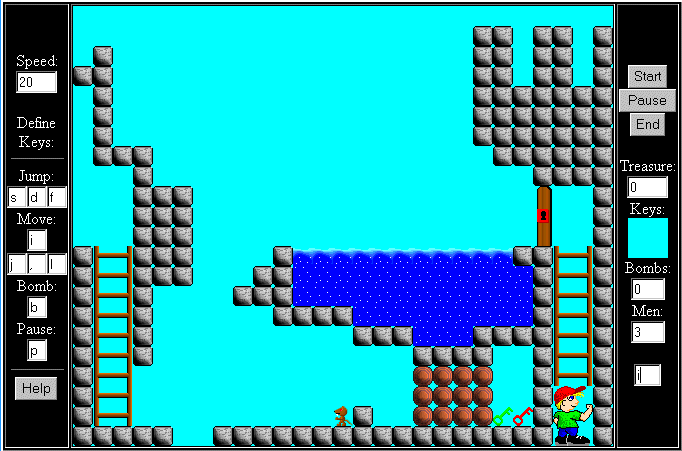 Screen Shot: Project BOB
|
|
Someday this space will contain more information about gaming, such as gaming codes, hints and tricks, and links to other gaming sites.
|
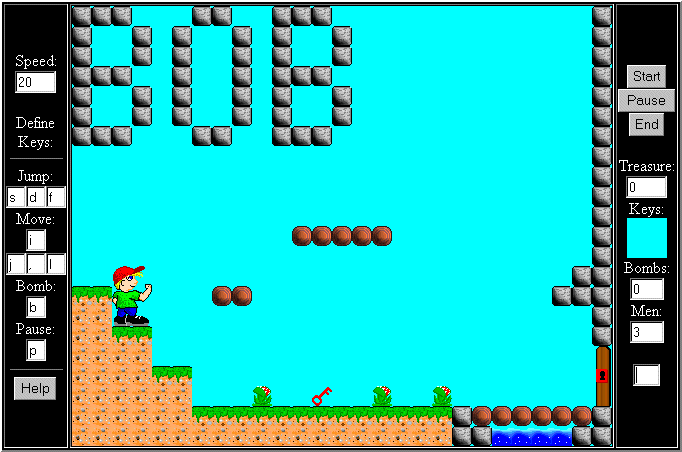 Screen Shot: Project BOB
|
Project BOB is fun to play.
|
|

