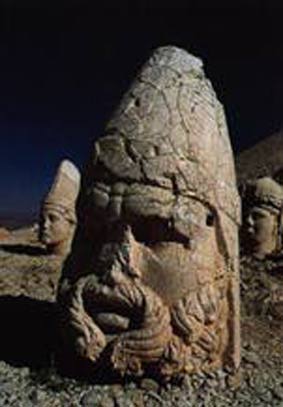
 The Chef God Zeus-Oromasdes
|
|
|
|
|
|
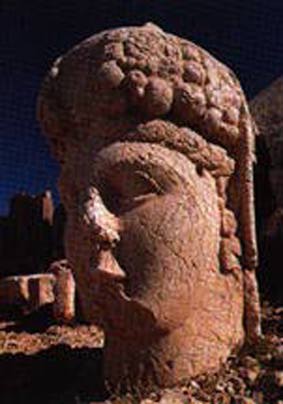 The Mother Goddess Commagene
|
|
|
|
|
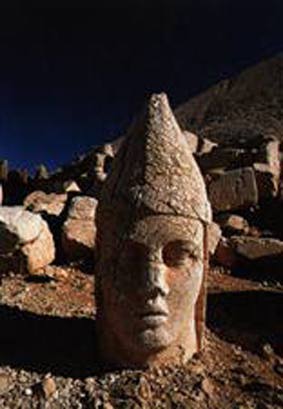 The Sun God Apollon-Mithras-Helios-Hermes
|
|
|
|
|
|
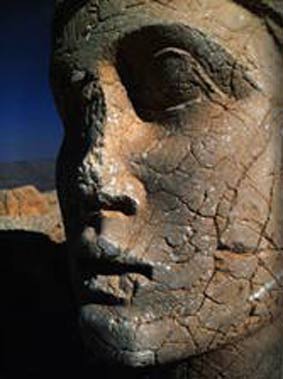 The God-King Antiochos I Epiphanes
|
|
|
|
|
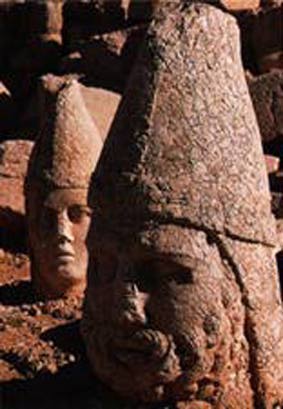 Heracles-Artagnes-Ares
|
|
|
|
|
|
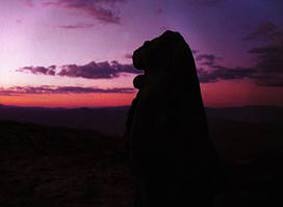 The Sunrise and a Lion
|
|
|
|
|
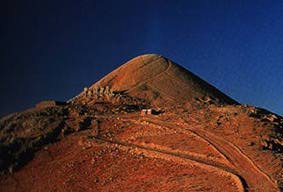 A View of Tumulus
|
|
|
|
|
|
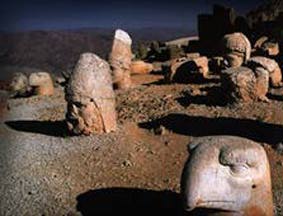 The west terrace
|
|
|
|
|
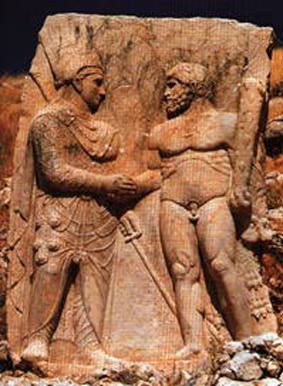 The Dexiosis Relief of Antiochos and Heracles in Arsameia
|
|
|
|
|
|
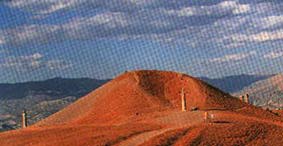 The Black Bird (Karakus) Tumulus
|
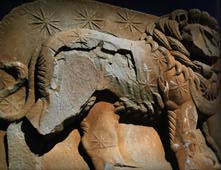
The Lion Horoscope
|
|
|
|
http://www.seyahatname.150m.com/
Limited distribution SC-87/CONF.005/9 Paris, 20 January 1988
UNITED NATIONS EDUCATIONAL, SCIENTIFIC AND CULTURAL ORGANIZATION CONVENTION CONCERNING THE PROTECTION OF THE WORLD CULTURAL AND NATURAL HERITAGE REPORT OF THE WORLD HERITAGE COMMITTEE
Eleventh session (Unesco Headquarters, 7-11 December 1987)
Nemrut Dag 448 Turkey C(i)(iii)(iv)The Committee took note of the undertaking of the representative of Turkey that the archaeological state of the site would be respectedduring the works foreseen in the next few years.
The kingdom of Kommagene was situated in the south east of Turkey, at the upper reaches of the Tigris and Euphrates rivers.
"Oaks and plane trees cover the hillsides. The valleys are full of fig, olive, walnut and pomegranate trees, grapevines and oleanders, nowhere do the corn fields give such an abundant harvest. " You can hardly imagine that this description was given less than one hundred years ago, by a German who travelled through this region. If you read his report, it seems as if he describes paradise. Indeed, it is said that here once blossomed the garden of Eden.
Today, this land resembles little its former paradise. Most of the trees have been felled and goats are busily eating away the last vestiges of vegetation. Nevertheless, irrigation, presently undertaken, will work miracles, and efforts are undertaken to refoster the land. The soil is very fertile and silver mountain water sparkles from the numerous springs.
In the past, Kommagene was a very rich region known for its wealth of minerals and ores such as brown coal, gypsum, iron, gold and petroleum. A part of this richness has been re-discovered. In the sixties for example, an archeologist panned succesfully for gold in the Euphrates.
Another discovery has been petroleum. During the last few years there has been extensive drilling for crude oil. verywhere on the landscape the oil riggs of the Turkish Petrol Organisation (TPO) are multiplying, drilling for black gold.
But now, we have to travel back in time. Around 850 B.C. Kommagene appears for the first time in the annals of written history. According to the records of an Assyrian king, the population had to pay an annual tribute to him of gold, silver and the famous wood of the cedar trees. Apparently, the valuable cedar tree not only grew on the hillsides of the Lebanon in those days, but also in Kommagene. Kommagene became a satellite state of the Assyrians.
Around 700 B.C. a Kommagenian king rebelled against the Assyrians. The Assyrian king, Sargon, defeated him. Sargon has given us a vivid description of this rebel king : " He is a godless man, who does not fear the gods. He plots only bad things and is full of cunning." We may assume that Sargons' description is a little subjective. Sargon continues : " I took his wife, his sons, his daughters, his possessions, his treasures, and finally I took the population of his land and had them deported to the south of Mesopotamia (Iraq). Nobody escaped. The people of the south of Mesopotamia I transferred to Kommagene." As we see, the policy of deporting people was already excercised in those days.
Around 600 B.C. the Assyrians were defeated by the Babylonians. The last battle was fought at Samosata, a town which would become the future capital of Kommagene. Here, at the banks of the Euphrates the remains of the Assyrian army had united with the Egyptian army to withstand the Babylonians. The Babylonian king defeated the united forces.
The people of Kommagene saw, how in their turn the Babylonians were replaced by the Persians, around 550 B.C. and then the Persians by the Greek intruders under Alexander the Great.
Around 300 B.C. one of the heirs of Alexander the Great came into possession of the land. It was King Seleukos I Nicator, who founded the dynasty of the Seleucides. He is one of the Greek ancestors of the Kommagenian kings. Around 130 B.C. Kommagene became an independent kingdom.
King Mithridates I Kallinikos
Like many of the other small kingdoms of Asia Minor, Kommagene was a melting pot of people from east and west. They had different cultures, habits and spoke different tongues. They certainly did not feel united as one people. Family ties and bonds of blood were more important than belonging to the people of Kommagene. King Mithridates did a great deal to change this a ttitude.
For example, he organised each year in Kommagene, Olympic Games in honour of the ancestors. Those games could virtually be compared with the Olympic Games of the Greeks. In his younger years, King Mithridates was one of the participants, which made him popular amongst the Kommagenians. His skills won him many victories. As a result of his sporting achievements, Mithridates received the honorable name Kallinikos. This means literally 'He who triumphs beautifully'.
Mithridates married a Seleucid princess, named Laodike. They begat three daughters and after bearing their fourth daughter, they began to despair of ever having a son. This was very important, as without a son there was no heir to the throne, so the stability of the kingdom would be threatened. The joy and relief when Laodike bore a son was immense. He was given the name of the father of Laodike, Antiochus.
Mithridates was in need of help, for Kommagene was surrounded by powers which outnumbered Kommagene many times. Therefore Mithridates concluded a treaty with the gods. We do not know whether these gods were real or imaginary. Obviously it helped to protect his small kingdom and keep it independent.
Secondly this treaty softened the mutual discordance of his people. The population of Kommagene was a varied mixture of people, coming from different origins. They hardly felt that they were related to each other. However, by this treaty with the gods, there grew the feeling amongst them that they were a chosen people, favored by the gods and under their protection.
As a consequence of this, Mithridates could forge a link between the different population groups in his kingdom. To honour this treaty, Mithridates had built all over the country small sanctuaries, called temenos.
The temenos of King Mithridates were built on top of striking points in the landscape. From there you could always see the most important of them all, the sanctuary on top of holy Mount Nemrud. Each of these sanctuaries consisted of five stone slabs, depicting King Mithridates shaking hands with one of the gods.
Mithridates gave each of the five gods a Greek and a Persian name :
Apollo/Mithras
Artagnes/Herakles
Zeus/Oromasdes
Hera/Teleia
Helios/Hermes
The Greek and Persian names of the gods meant that each Kommagenian, whether he had Greek or Persian ancestors, felt close to them. These stone slabs were known as steles. By these steles, Mithridates made everyone aware that through him alone, all of his subjects were under the protection of the gods. These temenos had to bear testimony of his treaty with the gods.
The five steles of King Mithridates I Kallinikos welcoming the Gods Apollo/Mithras, Artagnes/Herakles, Zeus/Oromasdes, Hera/Teleia and Helios/Hermes.
The 10th of Loos, the 14th of July was called the day of the "Manifestation of the Great Gods". It was also the day chosen for the coronation of Mithridates. Each year, on that particular day, all the citizens of Kommagene assembled at the small sanctuaries within reach of their village or town, to celebrate this occasion.
King Mithridates gathered together the nobles and other important men of Kommagene on top of Mount Nemrud. There, in the presence of hundreds of Kommagenians, the king received the representatives of the Great Gods. For the people of Kommagene this was the annual confirmation of their treaty with the gods.
King Antiochus I Theos
Antiochus, the son of King Mithridates, received an education from his parents which was a mixture of Greek and Persian. From his mothers side, queen Laodike, he descended from Alexander the Great. While from his fathers side, he descended from the Persian 'King of Kings', Darius I.
When Antiochus was still quite young, his father arranged a marriage for him with a Seleucid princess named Isias Philostorgos, 'the Beloved One'. Such a marriage had little to do with love, its purpose was purely political.
When Mithridates abdicated the throne in favor of his son, he stayed by his side. Together, they planned the sanctuary on top of Mount Nemrud. This was to be the spiritual centre of the treaty with the gods, for which Mithridates had lain the foundations.
As usual, Mithridates had a practical aim. It should become such an impressive monument, that it would give his subjects proof of the greatness of their treaty with the gods. As the Nemrud dominated the landscape, this proof could be seen by every Kommagenian from almost any place in Kommagene.
Antiochus had an idealistic aim. The cult of the treaty with the gods had to culminate in a new religion and Mount Nemrud was to become the centre. From Mount Nemrud his religion would radiate all over the civilised world. As the originator of this religion, he called himself Theos (God) directly after his coronation. A legend in his own mind !
For his father, Antiochus felt a deep respect, but his mother Laodike, he loved above all. He mentioned her specifically in various inscriptions, calling himself 'He who loves his mother'. He bestowed upon her the honorary name Thea (Goddess). Together with his mother he immortalised himself between the statues of the gods on Mount Nemrud. He, sitting at the left side of Zeus, as the king of Kommagene, Theos. She, sitting at the right hand of Zeus, as the mother of Kommagene, Thea.
Art
Kommagene had an art tradition which was completely its own. It was an unique synthesis of Greek and Persian art. Antiochus stimulated the art in a special way. He gathered together at his court a group of artists and scientists. They were called Philoi, the 'Friends of the King'.
Under the reign of King Mithridates the art was still dominated by eastern influences. During the reign of Antiochus, the style became more naturalistic and less stylised. Antiochus himself, preferred the Greek culture. He called himself literally a 'Friend of Greeks and Romans'.
The statues on top of Mount Nemrud became the crowning glory of Kommagenian art. Here, east and west fused into total harmony. A beautiful example is the head of Antiochus at the West Terrace. Any superfluous detail that could possibly disturb the form of the statue has been avoided. There are no luxuriant beards, jewelry and other ornaments. In this way a harmonic tension has been realised in the carving of Antiochus. Even today the gazing head of Antiochus impresses the people by its timeless beauty.
Trade
Trade was an important source of income. The growing difficulties between the Romans and the Parthians hindered the profitable trade between east and west. The only independent state between both super powers, Kommagene, was an acceptable trading partner for the Romans as well as the Parthians. The Kommagenian traders could travel freely through the land of the Parthians. They brought among other things, exotic animals and spices from India and silk from China.
Antiochus could levy heavy tolls, as he controlled the passes of the Taurus Range as well as the crossings of the Euphrates river. Because of its wealth, Kommagene was not only a transit point but could afford to import costly goods as well.
The traders sold their valuable wares in Samosata to Roman traders and prosperous Kommagenian citizens. Under the reign of Antiochus, Samaosata became the centre of trade between the east and west. Here, Parthians, Kommagenians, Romans, Greeks and Arabs met.
War with Rome
After the Romans had obtained a foothold in Western Turkey, they captured one by one, the kingdoms of Asia Minor, Bythinia, Pisidia, Galatia and Cappadocia.
After Pergamum, they captured around 80 B.C. Bythinia and Pisidia. At the same time the Parthians reached the borders of Kommagene.
Around 70 B.C., the Romans destroyed their greatest enemy, the kingdom of Pontus. Next, the Romans overran the mighty ally of Pontus, the kingdom of Arm. Tocomplete their conquest, the Romans continued swiftly to the last independent kingdom, Kommagene. Like a steam roller, they invaded this small country.
In 69 B.C. the capital of Kommagene, Samosata, was besieged. Then the unexpected happened. The Roman war machine was stopped. To their horror, the Roman soldiers were ombarded with an alien substance, unknown outside Kommagene. A Roman historian Plinius recorded; "a soldier who is touched by it, burns with all his weapons". Obviously the fear caused by this weapon was tremendous.
Samosata could not be captured. There was a personal meeting between the Roman consul Lucullus and King Antiochus. We do not know what they discussed, but it resulted in the withdrawal of the Roman legions.
Still, the situation remained tense for Kommagene, as it was caught between two walls. On one side, the imperialistic, warlike Romans and on the other, the powerful realm of the Parthians.
Map of Asia Minor 100 B.C.: Bythinia, Galatia, Cappadocia, Pisidia, Pontus, Arm, Seleucia, Kommagene, Parthia, Roma.
Map of Asia Minor 80 B.C.: Bythinia, Pergamum, Galatia, Cappadocia, Pisidia, Pontus, Arm, Seleucia, Kommagene, Parthia, Roma.
Map of Asia Minor 70 B.C.: Pontus, Arm, Seleucia, Kommagene, Parthia, Roma.
Map of Asia Minor 60 B.C.: Kommagene, Parthia, Roma.
In 64 B.C. the Romans continued their conquests. The remnants of the Seleucid state were swept away and absorbed into the province of Syria. By this time Rome had subjected all the independent states of Asia Minor, except for Kommagene.
Kommagene even profited from the fall of the Seleucid state, by gaining a limited extension of territory. From the strategic position of Kommagene, it was obvious that sooner or later Rome had to conquer that land or halt its eastward expansion.
Therefore, Antiochus reinforced his ties with the Parthians by giving his daughter, Laodike, in marriage to the Parthian king. They begat a son named Pakoros. He was the favourite of his father and heir to the throne.
The wars in Asia Minor continued. In 53 B.C. the Parthians defeated the Romans and conquered Syria
An important touristic site, possessing great natural, historical and cultural values, is Adiyaman, situated in the southeastern part of Turkey. At an altitude of 669m, the land is mountainous, the extensions of the Taurus Mountains covering the northern side. The famous Euphrates (Firat) River flows through the region and delineates the eastern and southern borders of the province.
Being very close to the plain of old Mesopotamia between the Tigris and Euphrates rivers, Adiyaman has been a center of history having witnessing the earliest ages. There exist artifacts dating back to the 4th- millenium BC, like the paintings in the Palanil Cave. Signs of neolithic and calcholithic ages are found at the tumuluses of Gritille and Samsat. Changing hands from Hittites to Commagenes, then from Seljuks to Ottomans, this province has seen many civilizations, remains of which are spread all over the land.
95 kms northeast from Adiyaman, the impressive peak of Mount Nemrut is the most outstanding landmark
of the region. It is the highest mountain of northern Mesopotamia, reaching a height of 2150 meters, and is
a unique historical treasure possessing marvelous sights. On its summit there exists the tumulus of
Antiochus I, one of the kings of Commagene, constructed in the 1stcentury BC. This mound, made by
heaping up pieces of rock, is surrounded by terraces where gigantic toppled heads of Apollo, Zeus,
Hercules, Tyche, and Antiochus from GrecoPersian style stone statues stand on the ground all of these
date from the same period. At the foot of the ancient Nymphaios (Eski Kale), there is the magnificent relief
of Hercules greeting the Commagene king, Mitradtes, and also evidence of remains which might have been
the Commagene Palace of opposite, separated by the Eski Kahta river, are the remains of Yeni Kale (new
castle) which was built by the Mameluks. Nearby are the remains of a Roman bridge at Cendere and the
Karakus royal tumulus. The Derik and Gerger fortresses, the Palanil Cave, the Haydaran Rock Tombs, the
Karadag Tumulus, Zey, Bestepeler and Malpinan are other historical sites worth visiting. Besides seeing
these historical beauties, it is worth to climb here to feel the charm of nature, coupled with the fascinating
views of sunrise and sunset.
Another interesting site is the necropolis of Pirin (Perre), 5 kms north of Adiyaman which is an ancient city
of early Roman times. At this site also called the "Pirin caves" there are 208 tombs carved into the rock,
with other remains some of which are still in use like the Roman fountain and Byzantine city walls. In
addition to the historical many ruins in the area, the Ataturk dam, the fourth largest in the world,
constructed across the river, Euphrates is here in this region being a special place of interest. This dam, 40
kms from Adiyaman, is the centerpiece of the enormous Southern Anatolian Project (GAP), provides for
agriculture and energy and is worth seeing. The lake to be formed will become an important tourist center in
the near future.
Other lakes found in this region are the Golbasi and Abdulharap Lakes beautifying the land with their
wonderful scenery, and offering wide opportunities for fishing and hunting. The mineral springs of
Celikhan, Kotur and Besni, on the other hand, are thermal centers to be visited for relief from various
illnesses.
A last stopover in this city should be at the Adiyaman Museum, which houses archaeological finds from
the area, together with the local ethnographic works. The specialty of the region is good quality kilims,
woven with various colors and sold at low prices.
|
|

